Philosophy

A gourd holds the universe; Go embodies wisdom.

The Way of the Gourd

Three-Layer Philosophy

From gathering to filling, then growing—this is the life of a gourd, and also the journey of learning chess.

Storage and Layout

The gourd is hollow yet holds much; the game of Go is endlessly varied and demands deep thought.

Teaching chess is like nurturing a gourd: it's not about how much you pour in, but guiding the child to absorb and store knowledge themselves. Just as a gourd's capacity determines how much it can hold, a child's potential depends on whether they truly internalize what they've learned.

Therefore, I prioritize guidance during the layout phase: helping children understand the intent behind each move rather than memorizing fixed joseki shapes. Knowing the "why" enables them to find their own path in unfamiliar positions.
Fulfillment and Growth

Every game builds experience; every move fosters growth.

There are no shortcuts to improving your Go strength. The tsumego you've solved, the games you've reviewed, and the decisions you've questioned will all become your intuition when you play. This process is slow, repetitive, and often frustrating—but it's unavoidable.

Take it slow and build each step solidly. Rather than rushing to a higher rank in the short term, I hope my child develops a steady thinking habit—one that will serve him for years and extend far beyond the board.

Growth and Transformation

From rank to level, from beginner to expert—grow like a gourd vine.

A gourd vine doesn't cover the trellis overnight; it grows segment by segment, gaining stability one joint at a time. Children develop the same way: there are rapid growth spurts and periods that seem stagnant—but those pauses are often when they're taking root.

As a teacher, my role is to recognize these two states: push when it's time to encourage progress, and wait patiently when it's time to let things unfold. It requires timing—nothing can be rushed or done for them.

"

When I first started teaching Go, I thought instructing lower-ranked students would be easy. After all, the material isn't deep; clarity should suffice. But as my teaching experience grew, I realized this is actually the most challenging phase.

It's challenging because children have limited attention spans, the same concept often needs to be explained in five different ways for them to understand, and what they learn today might be forgotten tomorrow. Every child has their own pace; every game requires patient guidance.

I realize that to raise a child well, I must keep learning and growing. Like a gourd, it only bears full fruit when it continuously fills itself. The same applies to teaching chess: only by constantly improving can I provide better guidance for the child.

Take it slow. Focus on each step and make sure it's solid.

Nanling Liren
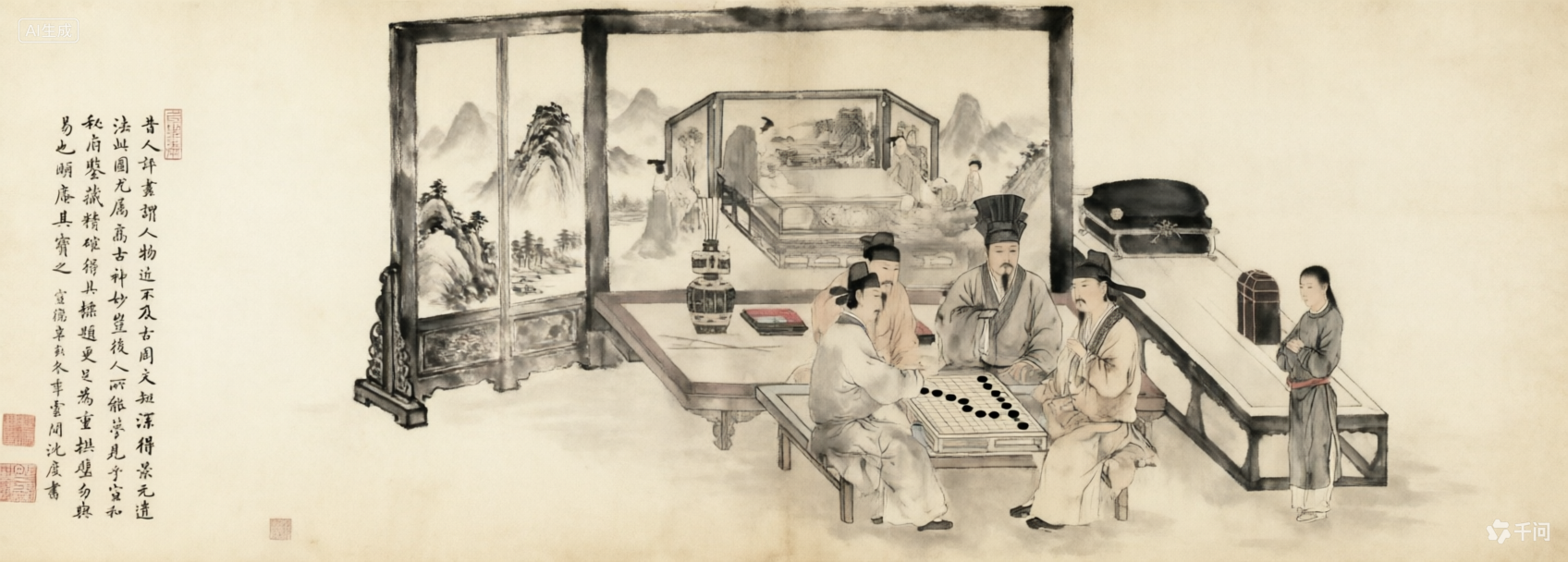
Ancient scholars playing a game of Go in an ink wash painting
Hulu Go Website HLWQ.TOP

A thousand years of chess tradition, passed down through generations.

Go has long been a path of self-cultivation for scholars and refined gentlemen. From the imperial court to common households, from study rooms to courtyards, a single game embodies the transmission of wisdom and character. The ancients ranked Go among the "Four Arts" (zither, chess, calligraphy, painting), valuing it not merely for winning or losing.

Every game holds choices, moves forward and back, patience, and decisive action. Through playing, children learn to face failure; through review, they practice self-reflection; through deep thinking, they hone focus. These lessons extend far beyond the board itself.

Gourd Weiqi upholds this tradition by centering its spirit on gourd culture, integrating the wisdom of Go into daily instruction to help students grow through the art of the game.

Conclusion

The gourd has form, the game changes, growth leaves no trace.

In teaching, what truly remains is not the solution to a specific life-and-death problem or the shape of a particular joseki, but the time when a child sits down, calms their mind, and thinks through something carefully.